
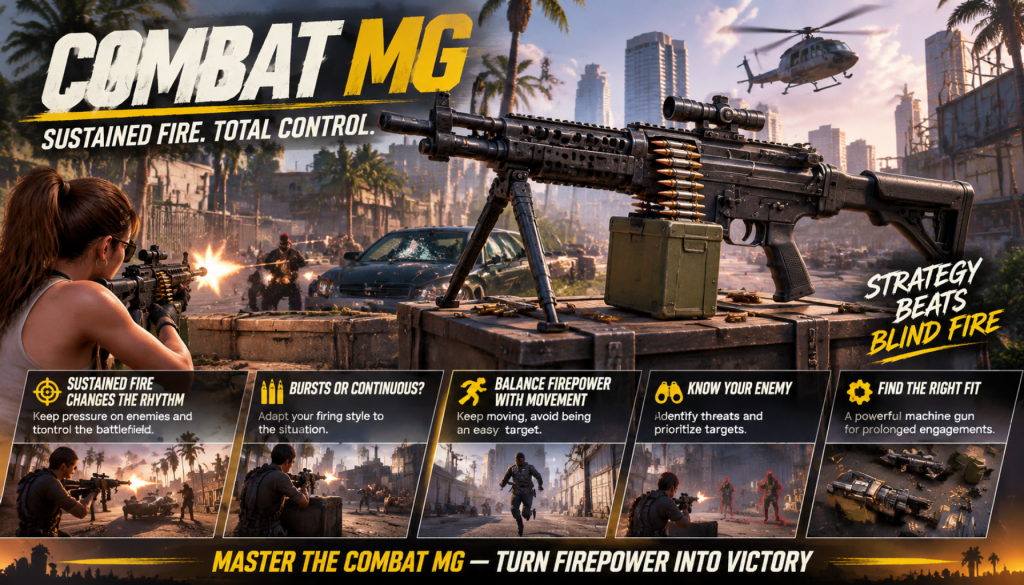
The Combat MG stands out among the firearms shown in the second official trailer for Grand Theft Auto VI. Its light machine gun design brings sustained automatic fire into focus, making it an interesting subject when examining the game’s combat presentation. Unlike conventional rifles that balance versatility with manageable handling, machine guns place greater emphasis on firing duration, ammunition use, and positioning. These characteristics influence how players approach crowded encounters, especially when several opponents occupy different angles. Weapon selection also connects with the wider online progression system, where managing GTA 6 Online Money can influence equipment preparation and access to different gameplay options.
Sustained Fire Changes the Rhythm of Gunfights
A machine gun’s ability to maintain automatic fire gives it a distinct role during intense encounters. When several opponents occupy an exposed area, sustained shooting can put pressure on their movement and make advancing more difficult. Instead of concentrating entirely on eliminating one target, players can use controlled fire to manage an approach and create opportunities to reassess the battlefield.
However, keeping the trigger pressed is rarely an efficient response to every threat. Extended firing consumes ammunition, makes recoil management more demanding, and can distract players from enemies approaching from other directions. A player concentrating on one opponent may overlook a second target moving toward a better firing angle. Effective machine gun use therefore depends on recognizing when additional fire serves a purpose and when it is time to change targets or reposition.
The number and location of opponents should determine how long each firing sequence lasts. A single exposed enemy usually does not require the same response as several opponents advancing through an open street. Adjusting firing duration to the situation keeps ammunition expenditure under control while allowing players to maintain pressure when it actually matters.
Continuous Fire and Short Bursts Serve Different Purposes
Sustained fire and controlled bursts offer different advantages. Longer firing sequences help maintain pressure when opponents are approaching from a predictable direction, while shorter bursts provide more opportunities to correct aim and react to changing movement. Understanding this distinction is particularly important when using a weapon designed around automatic fire.
Several combat situations highlight how these approaches differ:
- Controlling exposed areas: Longer bursts can discourage opponents from crossing open ground when the player has a stable firing position.
- Tracking moving targets: Shorter bursts make it easier to adjust aim as enemies move between vehicles, walls, and other forms of cover.
- Conserving ammunition: Controlled shooting avoids wasting rounds on targets that have already moved out of view.
- Handling multiple threats: Changing targets requires attention to enemy positions rather than concentrating all available firepower in one direction.
- Defending a position: Sustained shooting can maintain pressure on a known approach, provided the player remains aware of other possible attack angles.
The surrounding environment determines which approach is more effective. An opponent standing in the open presents a straightforward target, while someone firing from behind a vehicle requires a different response. Rapid movement between cover also makes precise target tracking more important than simply producing a large volume of fire. Weapon handling, recoil, and accuracy ultimately determine how effectively the Combat MG performs in these situations.
Firepower Must Be Balanced Against Movement
Heavy automatic firepower comes with an important tactical consideration: players cannot focus entirely on shooting while ignoring their own position. Remaining stationary provides a consistent firing angle, but it also makes movement predictable. Relocating too frequently creates another problem because changing positions interrupts firing opportunities and can expose players while they search for cover.
Urban environments make this balance particularly noticeable. An open street provides longer sightlines and more opportunities to identify approaching opponents, but nearby vehicles and buildings can also create several potential firing angles. A player focused on one direction may become vulnerable when another enemy approaches from the side.
Confined interiors demand a different approach. Shorter engagement distances leave less time to track targets, and opponents can appear from doorways or adjoining rooms with little warning. In these situations, movement, awareness, and quick target acquisition become especially important. A machine gun’s sustained firepower does not eliminate the need to make fast decisions.
Positioning also affects ammunition management. A player holding a protected angle can choose firing moments more carefully, whereas someone caught in an exposed location may feel pressured to shoot continuously. Moving behind suitable cover, checking nearby threats, and selecting a better firing angle can be more effective than trying to solve every encounter through additional gunfire.
Enemy Positioning Determines Where Firepower Matters
Enemy placement often has a greater influence on combat decisions than the number of available rounds. Opponents behind solid cover are difficult to engage directly, while exposed enemies provide clearer opportunities for accurate shooting. When threats occupy several angles, focusing on one target for too long can leave other approaches unprotected.
Consider an encounter in which several opponents are spread across a street. One enemy advances directly, another fires from behind a vehicle, and a third attempts to move toward the player’s flank. Continuing to shoot at the nearest target without reassessing the situation creates an obvious vulnerability. Identifying the most immediate threat, using available cover, and adjusting the firing direction are more useful responses.
The same principle applies when opponents move between buildings or use obstacles to break line of sight. Firing continuously at a position after an enemy has disappeared behind cover wastes ammunition and provides little tactical benefit. Recognizing when a target is no longer accessible helps players preserve resources and concentrate on threats they can actually engage.
The Combat MG’s sustained-fire role is most relevant when its ammunition is directed toward meaningful targets. Controlling an exposed approach, responding to an advancing group, and supporting a defensive position all require different firing decisions. Good battlefield awareness turns automatic fire into a tactical tool rather than an indiscriminate response.
How the Combat MG Fits Into GTA 6’s Weapon Balance
Different firearm categories serve different purposes, and that distinction is essential to a balanced weapon system. Assault rifles generally provide flexibility across several engagement distances, shotguns are suited to close-range encounters, and machine guns emphasize sustained firepower. Their strengths should encourage different decisions rather than make one category the obvious choice in every situation.
The Combat MG’s identity centers on maintaining pressure during prolonged engagements. Its usefulness depends on whether that advantage is balanced by limitations involving recoil, movement, reload frequency, or accuracy. A weapon that delivers substantial sustained firepower should require players to consider positioning and ammunition rather than simply outperforming lighter firearms in every encounter.
Several characteristics are particularly relevant when evaluating its role:
- Recoil behavior: Accuracy during extended firing determines how manageable automatic shooting remains.
- Ammunition capacity: Magazine size and reload frequency influence how players handle prolonged encounters.
- Movement handling: Mobility affects the balance between carrying heavy firepower and changing positions quickly.
- Effective range: Accuracy at different distances determines which combat environments suit the weapon.
- Customization: Available modifications can influence handling, appearance, and individual equipment preferences.
These characteristics provide a practical framework for evaluating the Combat MG without assigning it unconfirmed statistics. Its position in the weapon lineup will depend on how effectively its firepower, handling, and limitations work together. A well-balanced machine gun should offer a clear advantage in suitable encounters while leaving other firearms relevant in situations that demand greater mobility or precision.
A More Deliberate Approach to Every Shootout
The Combat MG brings attention to an important part of GTA 6’s combat experience: sustained firepower is only effective when supported by sound decisions. Firing duration, target selection, ammunition conservation, and positioning all influence the outcome of an encounter. Players who recognize when to maintain pressure and when to relocate can make better use of a machine gun than those who rely on continuous shooting alone.
Its actual performance must be judged through confirmed gameplay, particularly recoil, accuracy, movement handling, and ammunition behavior. These details will establish how it compares with rifles and other weapon categories. As players prepare equipment and explore different approaches to online progression, GTA 6 Boosting may also become part of broader discussions about improving their overall readiness. Ultimately, the Combat MG’s value comes down to its role in a firefight: controlling space, managing multiple threats, and delivering sustained fire without sacrificing awareness of the battlefield.
